AI Review Training and Narrower Judgments
Several AI reviewers reaching the same conclusion can feel reassuring. Agreement alone, however, does not establish that they independently checked the same problem. Similar learned judgments could also produce similar answers.
A September 17 preprint studies additional training of a Llama 3.1 8B reviewer on mixtures of official and generated reviews. Introducing generated reviews narrowed rating distributions and reduced semantic diversity. Its controlled experiment covers one model family, one domain, and one recursive training step. Paper and submission history
The central distinction is between judgments becoming more similar and judgments becoming incorrect. Conflating them misrepresents both the risk and the proposed remedies.
Assistance, generation, and training
Using AI to edit a person’s review, asking AI to produce a review, and training a successor on generated reviews intervene at different stages.
This experiment concerns the last stage. It is not a study of two agents talking themselves into agreement. Nor does the paper treat official reviews as guaranteed human-only writing or ground truth. Experimental setup and limitations
The distinction matters in everyday records too. “Reviewed by AI” says little about the process. To compare review methods, record which model drafted the work, whether another model read the original material, and whether it saw the first model’s conclusions before forming its own.
Equal means, different distributions
I constructed and calculated two sets of five ratings. These are teaching examples, not paper results or model outputs.
| Illustrative set | Ratings | Mean | Standard deviation |
|---|---|---|---|
| A | 2, 4, 6, 8, 10 | 6 | About 2.83 |
| B | 5, 6, 6, 6, 7 | 6 | About 0.63 |
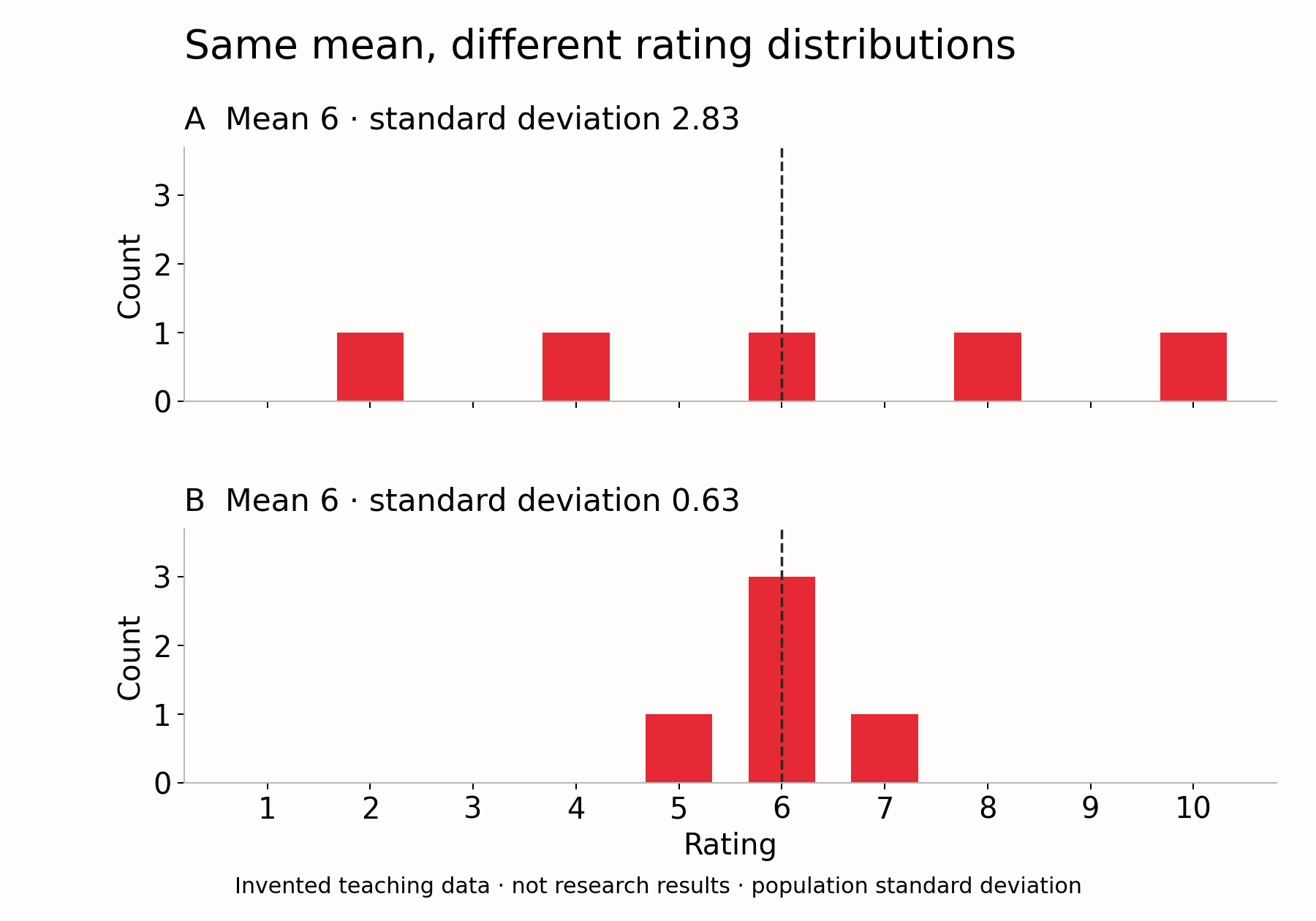
Standard deviation describes distance from the mean. Here I treat each set as the full population: square the distances, average them, and take the square root. B has the same mean as A but is concentrated near the middle. Reporting the mean alone hides that difference.
It does not follow that B is worse. If appropriate scores for the items were close to six, B might be more accurate. If the items differed substantially, B might erase meaningful distinctions. The distributions alone cannot decide between those explanations.
The lesson of this example is to measure diversity and accuracy separately. Neither “many different answers” nor “everyone agrees” is a sufficient quality rule.
Different wording and different findings
Different language need not represent different criticism. “The validation is insufficient” and “More evidence is needed” can express the same concern.
Conversely, similar wording can identify different errors. A “time-window mismatch” might concern the collection period in one review and the evaluation period in another. Distances between numerical representations of sentences cannot, by themselves, establish how many distinct valid concerns were found.
For practical review, I would break each finding into these fields. This is my proposed record structure, not a result from the paper.
| Field | Concrete example |
|---|---|
| Claim examined | The new feature preserves a saved value |
| Problem identified | Refreshing resets the value |
| Supporting evidence | An execution reproducing the failure with a specified input |
| Relationship to other reviews | Confirmation of the same bug or a separate failure |
| Verification after repair | The result of rerunning the same input |
This makes distinct confirmed failures more useful than a count of opinions. Reproducing the same bug twice is valuable, but it is not the discovery of two different bugs.
Where TrustReviewer intervenes
The released TrustReviewer separates training-data curation from intervention during generation. Its repository includes code and settings for adding a vector to the model’s internal representations. That acts at a different implementation layer from a prompt asking for more varied opinions. Inspected repository version
Adding a vector does not directly replace sentences. It adjusts intermediate numerical representations while the model computes subsequent tokens. A steering knob is a useful analogy for influencing a tendency, provided the knob is not imagined to point toward a guaranteed correct answer.
The released evaluator checks whether a generated rating matches an official rating and how far it lies from the official mean. Scoring well on these measures does not establish that the review’s factual criticisms are correct. Evaluation code
Suppose official ratings are four and eight. Matching either rating and matching their mean of six favor different answers. Choosing the metric changes what an improvement means. Before adding another score, define the question the evaluation should answer.
Evidence for an independent review
This study does not validate the effectiveness of an existing everyday agent-review workflow. It does suggest distinctions worth preserving when collecting review outputs.
My proposed comparison would give reviewers the same original material and criteria, while withholding other reviewers’ conclusions until their first reviews are complete. Then compare supporting evidence and confirmed errors, rather than agreement alone. This comparison has not been run.
The execution checks discussed in AI team integration checks remain necessary. One input that reproduces a failure can give a clearer repair target than three opinions that the code is wrong. An unreproduced concern does not become a confirmed defect because more reviewers repeat it.
The completion record should identify the claims checked, the evidence behind changes, and what remains unverified. A vote count cannot substitute for those records.
Sources and illustrative calculations checked September 21, 2026. The chart uses invented data. No TrustReviewer training, inference, or benchmark replication was performed.